
- Population: 105,350,020 people, or 88 people per square kilometer
- Official language: There is no official language, but Amharic is the working language
- from the government
- Form of Government: Federal Republic (Malatu Teshome)
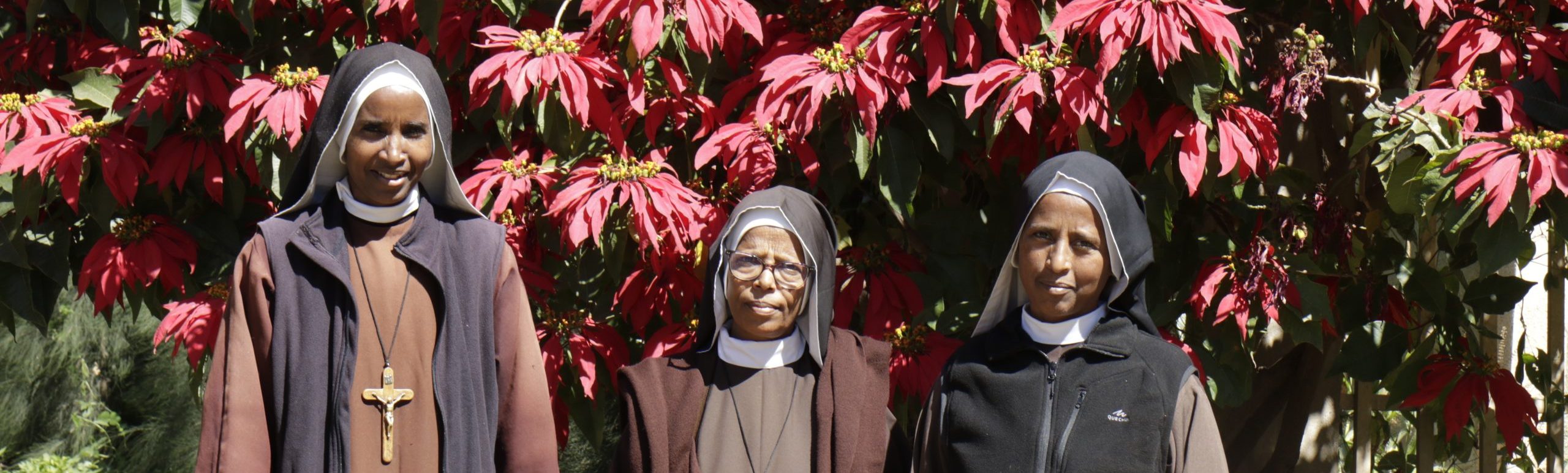
L’Œuvre d’Orient funded 96 projects in 2025
The Kingdom of Aksum was one of the world’s four great powers. In 324, King Ezana of Aksum was baptized, and Christianity became the kingdom’s official religion.
In the 16th and 17th centuries, the Catholic Church clashed violently with the Ethiopian Orthodox Church. The Jesuits, who arrived in 1557, were forced to leave Ethiopia in 1633. The situation calmed down in the 20th century.
1961: Founding of the Ethiopian Catholic Church:
– Today, it is one of the 23 Eastern Catholic Churches,
– It is led by the Metropolitan Archbishop of Addis Ababa (currently Cardinal Berhaneysus Demerew Souraphiel).
The Ethiopian Orthodox Church is known as Monophysite or Pre-Chalcedonian because it did not accept the conclusions of the Council of Chalcedon in 451.
1993: Meeting between John Paul II and Patriarch Abuna Paulos:
“We share the same faith handed down from the apostles, the same sacraments, and the same ministry rooted in the apostolic succession. Indeed, we can affirm today that we share the same faith in Christ, even though for a long time it was a cause of division between us,” the pope stated at the time.
2009: Meeting with Benedict XVI
2016: Meeting between Pope Francis and Patriarch Abouna Mathias.
It has approximately 750,000 members. It comprises two rites: an Eastern rite (Ge'ez) and a Latin rite, as well as 13 dioceses: 4 Ge'ez-rite eparchies and 9 Latin-rite apostolic vicariates. Although the Catholic Church is small in number, it is the leading provider of social services (400 schools, clinics, aid to the population, etc.) after the government and has organized itself accordingly. Christianity has been present in this country since the 4th century.
Today, according to UN figures, the population consists of:
Christians: 43% (Orthodox 2/3 and Protestants 1/3)
Muslims: 42%
Animists: 10%
Others: 5%
The Protestant community has experienced strong growth in recent years, with more than 1,000 officially registered churches today. Catholics account for barely 1% of the country’s total population.
An escalation of events led to two years of internecine fighting in the country. But behind this escalation lies a power struggle and a deep disagreement between the federal government and the Tigray region over their vision for Ethiopia.
18 months after the “end” of the fighting:
Militarily, the situation is largely stable. TPLF troops control virtually all of Tigray, with the exception of the western part, which is controlled by Amhara militias. They are virtually no longer present in the Amhara and Afar regions. Federal troops from the Addis Ababa government remain outside Tigray. In the first months of the war, numerous massacres of civilians took place (in Aksum, Mai-Kadra, Alitena, … and also in the Amhara and Afar regions), and a great many young people were conscripted into both sides’ forces.
In recent months, only 10% of the needed aid has been able to reach the region. It would take 100 trucks per day. Ninety percent of the population (5.2 million people) needs assistance. An estimated 400,000 people are on the brink of starvation.
In March 2022, the federal government in Addis Ababa declared a humanitarian ceasefire, which it is hoped will allow for a larger delivery of food aid to Tigray. Unfortunately, one month later, the situation has barely improved and remains very critical.
The situation is also critical in the Amhara and Afar regions.

