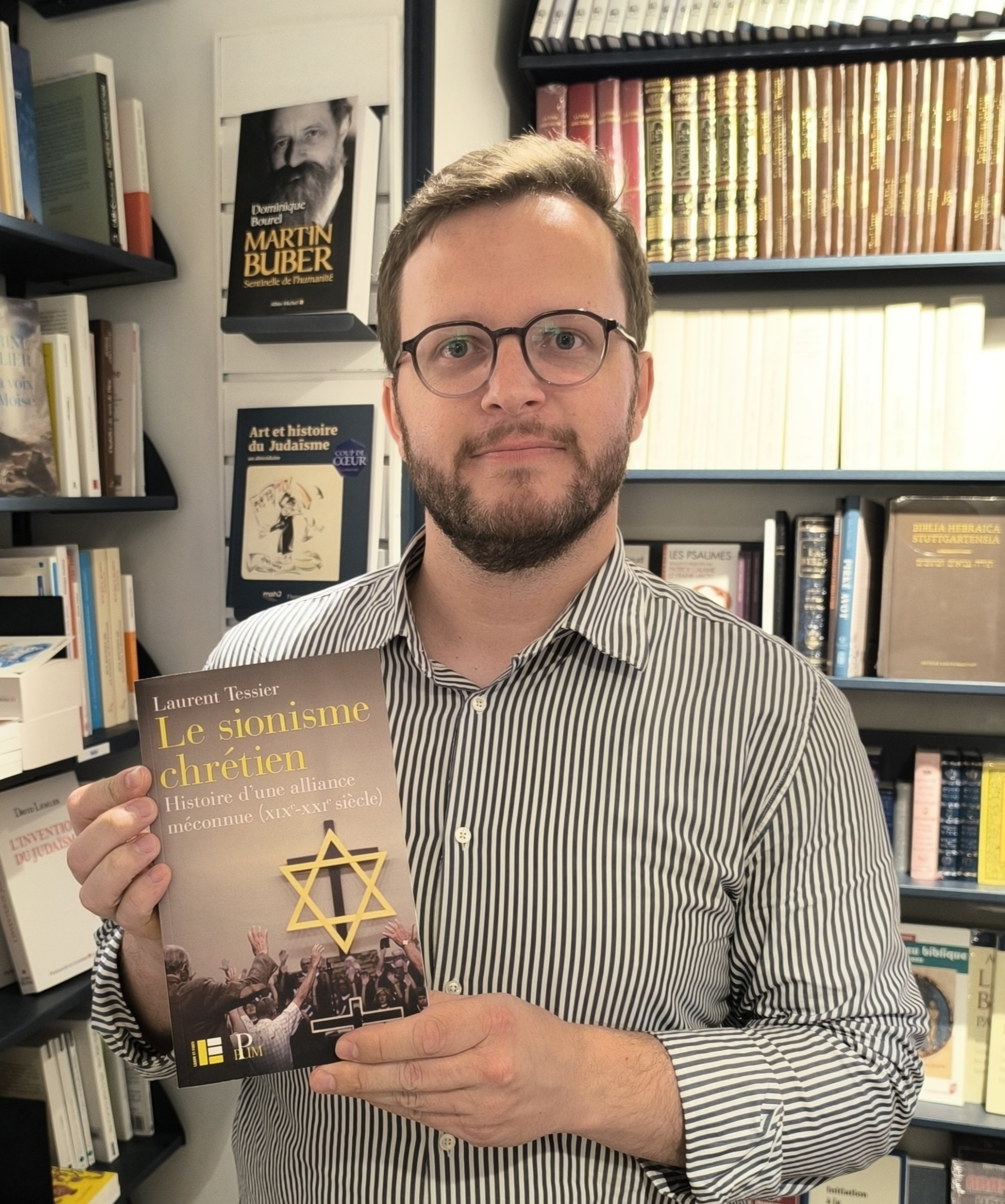
An Interview with Laurent Tessier, author of the book *Christian Zionism: History of a Little-Known Alliance (19th–21st Centuries)*, co-published by Labor et Fides and the University of Montreal Press, 2026.
With a Ph.D. in the history of religions, it was in England and on the North American continent—in Canada and the United States— the three birthplaces of Christian Zionism, that Laurent Tessier—a graduate of the École Pratique des Hautes Études in Paris and the University of Montreal—conducted his research to turn his dissertation into a book intended for a wider audience.
In particular, he worked in Montreal and Ottawa, Canada, where he had access to previously unpublished archival materials. It is a monumental work, rich in English-language authors who are definitely worth discovering.
Q – In the extensive bibliography of your book, French authors are conspicuously absent…
The only French-language book written entirely on this subject is Celia Belin’s *Jésus est juif en Amérique* (*Jesus Is Jewish in America*), published in 2011 by Fayard. I actually met the author while working on this project. However, French-language works on this subject are rare or limited in scope (*1*).
Q- Why?
Because in France, unlike in Anglo-Saxon countries, religion is not considered a determining factor. French politicians and journalists often highlight issues related to secularism, and debates frequently boil down to pitting those in favor against those opposed, without taking the time to analyze people’s backgrounds in depth and by relegating religious influences to secondary concerns.
Q- Is that how you felt while working on the North American continent?
Yes, and during the years when I met North American researchers.
In France, the media sometimes allude to Zionism when discussing American evangelicals, but without really delving into the subject.
It was during one of my trips to Canada in 2015 that I realized the full extent of the phenomenon. Zionism was a central part of the foreign policy of the government of Stephen Harper, the Canadian prime minister at the time, who had taken support for Israel to the highest level and in the most uncompromising manner.
Q- In your opinion, should religion be given more attention in political analyses?
This is an important issue that cannot be overlooked. For it is a powerful catalyst for mobilization and commitment—both in the service of peace and in the service of violence.
For that reason alone, religion deserves greater attention—attention that goes beyond the condemnation with which the debate is all too often concluded.
Q: What led you to choose this topic?
I am interested in international relations, and particularly in the geopolitics of religion—the ways in which religious actors behave, the worldviews and conceptions of how the world is organized that they embody, and the ways in which their beliefs and values shape their commitment.
The issue itself is of paramount importance. The Israeli-Palestinian conflict—and, more broadly, the question of Palestine—is both a historical and a current reality that Europe has witnessed for decades. It is often presented as a clash between two forms of nationalism, which—through the very phrase “Israeli-Palestinian conflict”—suggests a roughly balanced opposition between Muslim Arabs on one side and Israeli Jews on the other. The reality is far more complex, but we rarely take the time to consider it.
Christian Zionism specifically shatters this binary view by introducing a third party: the Christian community, which has long been outside the Middle East. It nevertheless highlights the actively pro-Zionist role played by Anglo-Saxon Christians, in this case, since the mid-19th century.
Talking about Christian Zionism also means restoring the rightful place of Arab Christians in Palestine, who today see it as one of the main threats to their existence.
Q- What about Canada?
Within this vast landscape, Canada remains a blind spot: everything is written from the perspective of the United States. Yet Canada is a fascinating case. A Commonwealth country, heir to the British world and neighbor to American evangelicalism, where these networks have flourished. My work in Montreal has also given me access to valuable archives that are impossible to find in France.
Q- How many years of work experience?
About ten years of work. My research began in 2016; I defended my dissertation in 2024; and the book was published two years later, in 2026. I expanded my work to the United States with the goal of making this book accessible to a wide audience.
Luc Balbont
(*1) We should also mention Professor Lionel Ifrah’s books: *Moses in Washington: The Biblical Roots of the United States* and *Zion and Albion: Jews and Puritans Await the Messiah* (Honoré Champion)