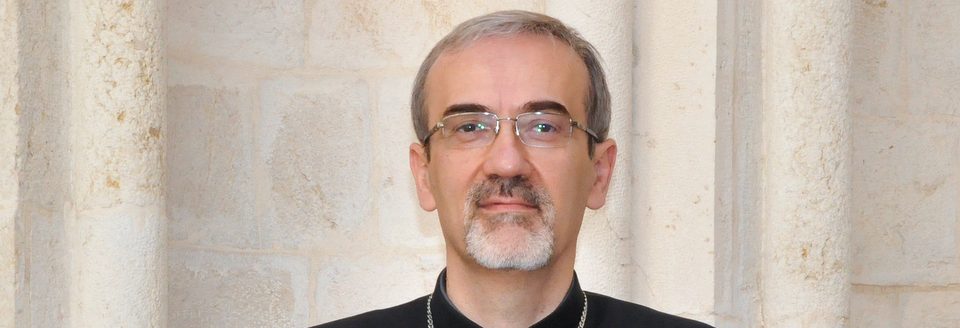
Interview on June 11, 2026, by Pierre Jova (La Vie)
During a visit to France from June 8 to 14, 2026, the Latin Patriarch of Jerusalem reiterated his conviction: to rebuild bridges between the Israeli and Palestinian communities, and to never give up hope for the blood-stained Holy Land.
A reed bends but does not break. That is the impression we get every time we meet Cardinal Pierbattista Pizzaballa. Born in 1965, this Italian Franciscan has served as Latin Patriarch of Jerusalem since 2020, overseeing the Roman Catholic Church in Israel, the Palestinian Territories, Jordan, and Cyprus. A former Custos (Custodian of the Holy Places), he speaks Hebrew and has an intimate understanding of Israeli society.
Upon arriving in France on June 8, 2026, the cardinal visited Paris and will be in Paray-le-Monial (Saône-et-Loire) from June 11 to 14—a shrine he has not yet visited—to preach on the connection between Jerusalem and the Sacred Heart of Jesus.
Accompanied in the capital by the Œuvre d’Orient, the patriarch had the opportunity to be received at the Élysée Palace and the Senate, but not at the National Assembly: its president, Yaël Braun-Pivet, reportedly vetoed the visit, depriving lawmakers of valuable insight into the Israeli-Palestinian conflict.
Since October 7, 2023, Pierbattista Pizzaballa’s ministry has been plunged even deeper into tragedy. Condemning without reservation both Hamas’s actions and the military onslaught on Gaza as well as the extent of settlement expansion, Pierbattista Pizzaballa is walking a difficult tightrope, which has earned him criticism from both sides.
In his exclusive interview with *La Vie*, conducted at the offices of the *Œuvre d’Orient* in Paris, Pierbattista Pizzaballa made a discreet allusion to these difficulties but remained steadfast. This deeply spiritual man, nourished by the Bible, rooted in prayer, and averse to worldly affairs, is convinced that there is too much politics in this war… and not enough religion. A bold assessment that is sure to unsettle secular Western minds.
It was in this spirit that he published a pastoral letter titled *Proposal for Living Out the Church’s Vocation in the Holy Land* in April 2026. This landmark document does not shy away from any issues or debates and offers Christian perspectives grounded in the reality of the communities under his care.
The interview he granted us reflects the vision of a prelate who, on July 21, 2025, was in Gaza that morning with Christian refugees at the Holy Family parish, and in Ein Karem that afternoon, to celebrate the funeral of Sister Regine Canetti, a Jew who had converted to Catholicism, before an assembly of uniformed Israeli conscripts. A man not torn apart, but at the foot of the Cross, suffering and interceding for all.
You received the Legion of Honor from French President Emmanuel Macron. What does this honor mean to you?
I consider this honor to be bestowed not only on me personally, but also on what I represent today—namely, the Church in the Holy Land, and in particular the Catholic Church. It is a recognition of the service, the life, and the witness that the Church has always offered, particularly through its schools, hospitals, and all of its charitable works. It is a presence that reaches out to the world.
In fact, this is one of the defining characteristics of the Catholic Church in the Holy Land: working in the service of all. This distinction also recognizes the work of many men and women religious, many of whom are French. Many Catholic institutions have French origins. It is therefore also a way of honoring their work, their witness, and the legacy they have left behind.
Does France, as a nation, still have a role to play in helping Christians in the Middle East and the Holy Land?
I don’t think we should view Christians as a separate group. We must be careful: this is not about supporting Christians at the expense of others. Of course, their situation is important. France has played a historic role in the Middle East for several centuries. It is essential that it use this role to address the political, social, and cultural realities of the Middle East in order to help the region move forward as much as possible. This includes Christians.
But it is also important to remind everyone that Christians are an integral part of life in the Middle East. We must therefore discuss them in a broader context, as full-fledged citizens of their countries.
As conflicts continue in the Middle East, Lebanon, Iran, and elsewhere, you wrote in your pastoral letter of April 2026 that “war has become the object of idolatrous worship: (…) an end in itself.” How can Christians promote peace?
If we claim to solve all political problems, we will inevitably be disappointed! We must remain true to who we are. Our mission is to help, as much as possible, build a culture of peace within our institutions, particularly in our schools, where the Church plays an important role in the Middle East. It is also about creating networks among all the associations, groups, and movements that continue to believe that another way of living together is possible. This is how we work for peace: by refusing to leave the narrative and the field solely to extremists.
Speaking of extremism, those familiar with Jerusalem are aware of the attacks and harassment directed at the Armenian Quarter and the Dormition Abbey in Jerusalem by radical Jews. In May 2026, a French nun, Sister Marie-Reine, was attacked. Do Christians still have a place in the city?
Now more than ever! Once again, we must not let extremists dictate the narrative. This is not just a matter of language, but also of our presence in everyday life. What is happening today is troubling, and I fear it will continue.
It is precisely for this reason that we must reaffirm our presence, while remaining true to our identity and our way of being. We must maintain our style. We must not adopt the same language as those who attack us. We must be firm when necessary—clear and determined—without ever giving up on dialogue.
What do you mean when you say “staying true to our style”?
The Christian way! Nonviolence. And nonviolence isn’t just about physical actions. It also applies to our language—what we say in our families, in our schools, and in our institutions. It’s about maintaining this attitude of openness to encountering others, of welcoming them, and of refusing to view them as a threat. It’s not always easy, because fear is very much present.
It is important to remember that verbal abuse always precedes physical violence. In Israel, it is unfortunately perpetuated at the very highest levels of government. It fosters the dehumanization of “the other,” a process that began well before October 7.
In January 2026, a statement by the patriarchs and heads of the Churches of Jerusalem described Christian Zionism as a “harmful ideology,” one that is harmful to everyone and especially to Christians. Why is it important to denounce this ideology?
To be honest, I don't know if that statement was worded perfectly. In any case, the substance of the issue remains. Certain Christian movements, especially evangelical ones, are developing an interpretation of the Bible that assigns direct political significance to certain contemporary events. In our view, this approach is problematic. These groups are often exploited or manipulated.
What we wanted to emphasize is the need to distinguish between political dynamics and the interpretation of Scripture and the life of the churches. Some view the current State of Israel as the direct fulfillment of biblical promises. For us, this is a complex interpretation that is difficult to accept at face value. The subject is very broad and cannot be summarized in a few lines. But it does have the merit of raising an important debate. Let us remember that there are many forms of Zionism.
The Palestinian Christian village of Taybeh, in the West Bank, is targeted almost daily by attacks from radical settlers. Why isn’t the Israeli government taking action?
I’m asking myself exactly the same question. I’d like to see the government take the necessary steps to restore the rule of law in the West Bank. Unfortunately, that is not the case. This situation is causing a great deal of frustration and suffering among Christians. But what is happening in Taybeh is also happening in many other places. This village is a symptom of the impunity that is ravaging Palestine. This impunity and this violence are deeply traumatizing the Palestinian people.
In your pastoral letter, you refer to the so-called “two-state solution.” You write that “these words, which have shaped our discourse for years, now seem worn out and meaningless to us,” while adding that “there is no alternative. This land—so contested and so beloved—is home to everyone.” Without asking you to take a political stance, would you be in favor of a single, shared, and egalitarian state for all?
I support any solution that the two peoples themselves agree to. No one from the outside can impose a solution on the Israelis and the Palestinians. The role of the international community is to help them find a way forward, whether that involves two states, a single state, or any other arrangement. If I wrote that these concepts seem outdated, it is because the reality on the ground today tells a very different story.
The Israeli-Palestinian conflict is nothing new, but October 7 marked an irreversible turning point in the lives of both peoples. For Israeli Jews, these events are seen as a “mini-Holocaust.” The average Israeli is convinced that the Palestinians can no longer be trusted. On the other side, the destruction of Gaza is fueling the same sentiment. Hatred and mistrust have reached unprecedented levels. And we are witnessing something new: the mutual ties between Israelis and Palestinians, within the two societies themselves, are deteriorating and breaking down.
We cannot, therefore, return to the status quo ante. Before discussing institutional solutions, we must first rebuild trust.
Is that still possible?
It seems impossible, but it's essential. Without mutual trust, how could they ever reach a solution?
In your pastoral letter, you also write: “Ignoring the ‘vertical’ dimension of our land—that is, the religious and spiritual sensibilities of the communities that make it up—Jewish, Muslim, and Christian—is the root cause of the failure of the successive coexistence agreements over the past few decades. ” This statement may surprise many Europeans, who often believe that religion is precisely the cause of conflicts in the region.
On the contrary. All the agreements proposed to resolve the conflict have been drafted without taking the religious dimension into account. Yet, when it comes to holy sites, sacred times, and symbolic spaces, it is impossible to talk about Jerusalem—and to seek to divide it—without taking into account what this city represents for all Jews, Christians, and Muslims. This dimension is an integral part of the communities’ lives. Ignoring it gives the impression of a plan imposed from the outside. The problem is not religion itself, but the way it is used or interpreted. Of course, religions also have their limitations and contradictions. But we must work through these difficulties to achieve something stable and lasting.
This reflection reminds me of the account of a former Israeli conscript who went to India to put the Gaza war behind him, as reported by the Italian newspaper *La Repubblica* in August 2025, who said: “India is a land of spirituality, unlike Israel. ” This remark is surprising to Europeans, who often think exactly the opposite.
It all depends on how one experiences spirituality. In the Holy Land, spirituality is co-opted by institutions or by rigid interpretations of religion. This is a risk we face everywhere. In this conflict, there is both too little religion and too much politics. What we see is essentially politics cloaked in religious garb. This mix is always dangerous.
How can we restore spirituality to its rightful place?
We need spiritual leaders (smile).
In your pastoral letter, you write that “our schools are perhaps the greatest gift the Church offers to this land.” Why are Christian schools so important in the Holy Land?
In Gaza, we have 600 students, the majority of whom are Muslim, and we hope to enroll 1,000 students soon, with the help of the Œuvre d’Orient and France. Our schools are the only ones that are not organized along ethnic or religious lines.
There are some 150 Christian schools in the Holy Land—and not just Catholic ones. There is a network of hundreds of Christian schools that serve tens of thousands—or even hundreds of thousands—of students throughout the Middle East. When you consider that Christians make up barely 1 to 2 percent of the region’s population, reaching such a large number of students also means reaching hundreds of thousands of families.
School is more than just a tool: it is a place where the Church can share its vision of humanity and contribute to civil society. It is also a place where dialogue takes place on a daily basis among students, teachers, and families. Education is not just about imparting knowledge; it also prepares students for life. We support children from preschool through high school. This is an extraordinary opportunity to positively influence an entire generation. We cannot change everything, but we can make a substantial contribution.
For so many decades now, conflict has become a part of our lives. I don’t think it will end anytime soon, though I hope I’m wrong! We need to help young people come to terms with this situation and cope with the immense frustration it causes. School is the right place to help them develop critical thinking skills and to encourage them to be creative and take civic initiative.
During our last meeting in Jerusalem in 2023, you explained that you wanted to foster the emergence of a Christian middle class, believing that it transforms society more than the elites do. How can this be achieved when so many Christians are emigrating?
Emigration is indeed a major obstacle. Those who leave often belong to the middle class. They are the ones who can make a vital contribution to society: entrepreneurs, doctors, lawyers, academics, cultural figures… They often serve as the community’s showcase and demonstrate its ability to contribute to the common good. The current economic situation and tensions are putting all of this at risk.
However, while there are certainly people who are leaving, there are also those who wish to stay. We must not only work to maintain the quantity of the Christian presence, but above all to ensure its quality. The most important thing is not to stay, but to have something to say.
That is why we must work to train a new generation of local Christian leaders. This is also why we are developing spiritual formation centers for Arabic-speaking laypersons in Israel and Palestine, to give them the tools they need to deepen their faith, learn about their history, and become familiar with the Church’s social teaching. This is just as important an issue as economic matters.
We’ve all seen the image of that Israeli soldier attacking a crucifix in Lebanon in April 2026. Many Israeli Jews know nothing about Christianity. How can we change this situation?
We shouldn’t generalize. Not all Israelis share these attitudes. What happened is very sad. It’s a symptom of a problem present in part of Israeli society, but certainly not in its entirety. It’s true that we shouldn’t underestimate this phenomenon. There is a very intense debate over identity in Israel, which reflects an intrinsic fragility and manifests itself in rigidity and violence cloaked in a religious dimension.
The Church cannot simply condemn these acts. We must continue to engage in dialogue and create opportunities for encounter. We must also help the relevant institutions address these issues appropriately.
At the risk of surprising you, I believe that the attack on Sister Marie-Reine in May 2026 was what we sing about during the Easter liturgy: a Felix culpa (“happy fault” or “blessed fault,” a theological expression meaning that original sin justified the Redemption—Ed.)! This attack helped raise awareness of this issue within Israeli society. We have received countless expressions of support from Israeli Jews.
However, we feel that Israeli society lacks people who are willing to engage in dialogue with Christians.
That is indeed one of our problems. We don’t have enough people to talk to. We need to keep at it. The language barrier also plays a role. Few of us Christian leaders speak Hebrew or truly understand Jewish society. We also need to prepare our own communities for this encounter.
In your pastoral letter, you express concern about the military use of artificial intelligence, which we know is becoming widespread in the Israeli military. Do you think the Pope’s recent encyclical marks the beginning of a response to these challenges?
I don’t think it was written in response to my pastoral letter! But yes, it’s certainly one of the first texts to address this issue in a relatively systematic way. The subject is extremely complex, both ethically and technologically. This text opens up a high-level debate, but also addresses cultural and legal dimensions. That’s very important. I hope it will contribute to the emergence of common principles that can be recognized by the entire international community.
We have discussed France’s role as a nation. What concrete steps can French Christians take to support their brothers and sisters in Christ—and as fellow human beings—in Israel and Palestine?
First and foremost, pray. Prayer is the most important act for a believer. Next, support the many organizations working on the ground. It is also important to gain a better understanding of the reality of the Holy Land and, whenever possible, to make the pilgrimage once again.
I understand that this is complicated today, but we must hold on to that desire. We must also discuss these issues, raise awareness among those around us, establish sister city partnerships, build connections, and foster lasting relationships. The Christian network in the Holy Land thrives largely thanks to these connections and pilgrimages, particularly in the Jerusalem and Bethlehem regions. It is essential to keep this connection alive.
Source: La Vie – https://www.lavie.fr/christianisme/pierbattista-pizzaballa-en-terre-sainte-la-spiritualite-est-confisquee-104486.php