
- Population: 8,847,000, or 413 people per square kilometer
- Official languages: Hebrew
- Form of Government: Parliamentary Republic (Reuven Rivlin)
Israel is the only country in the world where the population is predominantly Jewish (75.5%). The non-Jewish population breaks down as follows: Arabs (20.4%), Druze (1.8%), Samaritans, Bedouins, etc.
Christians account for more than 2% of the population. There are 150,000 of them, mainly Latin and Greek Melkites. The 13 official Churches of the Holy Land meet regularly to coordinate their efforts.
The highest Latin Catholic authority in the East bears the title of Latin Patriarch of Jerusalem. He resides in Jerusalem and has jurisdiction over Latin Rite Catholics in Palestine, Israel, Jordan, and Cyprus, the majority of whom are of Eastern origin. Since the retirement of His Beatitude Fouad Twal on June 24, 2016, the patriarchate has been under the authority of an apostolic administrator, the Franciscan Archbishop Pierbattista Pizzaballa.
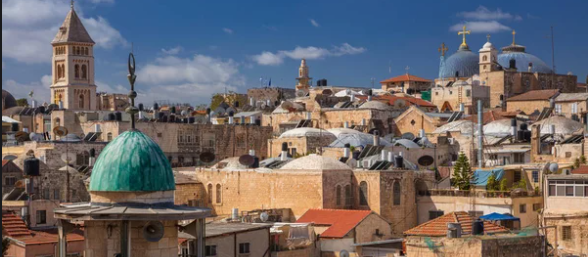
Jerusalem is the city that is home to the holy sites of the three major monotheistic religions.
The Holy Land is the name Christians give to the region where Jesus Christ was born and lived. Based on the sites mentioned in the Gospels that Jesus Christ visited, the Holy Land today corresponds geographically to:
– Israel, including the annexed Syrian territory of the Golan Heights (around the region of Baniyas, Paneas, or Caesarea Philippi),
– the territories under Palestinian authority (the West Bank and the Gaza Strip),
– the southern coast of Lebanon (including Tyre and Sidon),
– and Jordan (Bethany Beyond the Jordan),
– as well as the episode of the flight into Egypt.
Christians are not merely a minority in the Holy Land. They are an integral part of this land’s identity, just as the land is an integral part of their identity. Without these Christians, the Holy Land would not be the Holy Land, and without the Holy Land, they would not be who they are.

