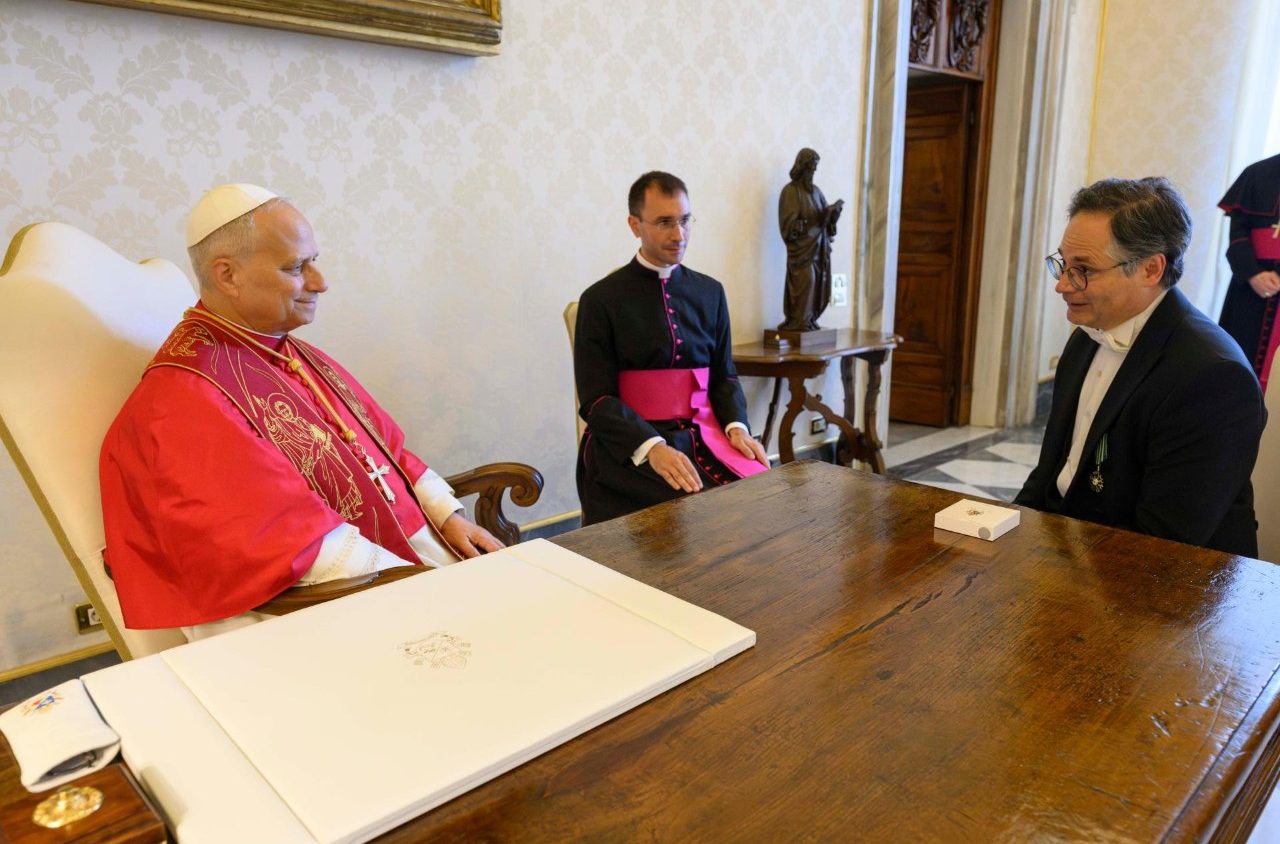
Charles Personnaz, who was received by Leo XIV on Friday, June 5, to present his credentials, is an expert on Eastern Christians. As president of the Fonds des écoles d’Orient and an active member of the Œuvre d’Orient, he hopes, together with the Holy See, “to try to find ways to achieve greater peace, or at least dialogue, among peoples.”
Jean-Charles Putzolu – Vatican City
Beginning his assignment with the Holy See—the first diplomatic posting of his career—Charles Personnaz presented his credentials to Pope Leo XIV on Friday, June 5. This senior official, who until now served as director of the National Heritage Institute and who will continue to serve as president of the Support Fund for French-Speaking Schools in the Middle East, arrives in Rome amid a turbulent period for the people of the Middle East.
One of his missions will be “to maintain and enrich this dialogue between France and the Holy See.” “Because France and the Holy See are two centers of reason, places where we seek ways and means to defuse this international situation, in an effort to find ways to achieve greater peace or at least dialogue among peoples,” Charles Personnaz said in an interview with Vatican media.
Eastern Christians
Committed to education through the Fund he chairs—established in 2020 by President Emmanuel Macron—and through his work with the association L’Œuvre d’Orient in support of Eastern Christian communities, Charles Personnaz has a deep understanding of the realities and complexities on the ground. When asked about the scale of the exodus of Christians in the wake of the wars that have unfortunately followed one another—whether in Iraq, Syria, the Palestinian Territories, or Lebanon—he does not hide a certain concern. “We should be concerned. I believe, however, that the situation is not set in stone, as we see a vital force within these communities, albeit a weakened one,” he says, without succumbing to resignation.
“These forces have been weakened, but they still exist. The network of schools and social service organizations endures, and I believe that this is what not only Christians but also the societies in which they live must rely on to build the future.” In this context of tension, “it is clear that the crisis in Lebanon involves an extremely important issue, because Lebanon remains a point of reference for Christians throughout the region, and therefore the future of Lebanon also determines the hope of all Christian communities in the Middle East”.
The Role of the International Community
In the conflict between Israel and the pro-Iranian Hezbollah in Lebanon, Western countries seem to be struggling to intervene. France has asked the United Nations Security Council to address Israel’s military advance into southern Lebanon. According to France’s new ambassador to the Holy See, “part of the solution will also come from Lebanese unity,” and it is therefore important that the international community remain engaged. “I think everyone is looking to the other side. The international community is looking to the national community, and vice versa. And in fact, the two need to find common ground. And that, I believe, is the biggest—and most difficult—challenge today.”
The Conditions for Peace
If we are to build a peaceful future for the Middle East and encourage the return of the hundreds of thousands of Christians who left in search of better living conditions abroad, Charles Personnaz believes there are at least three essential conditions that must be met. First, restore a climate of security: “return to a state of calm in the region, bring all possible political influence to bear, and support all initiatives that move in that direction.” Second, ensure acceptable economic conditions so that communities—“both Christians and Muslims”—no longer feel compelled to risk the journey into exile. Third, expand social services and education.
Ranked third by Charles Personnaz, education is far from being the lowest priority. The president of the Fonds des écoles d’orient states, “Education is a fundamental path. “In the Middle East, we know very well that many countries are held together by their school systems, and despite the crises, schools continue to operate.” In the nearly 200 schools and six universities supported by the Fonds des écoles d’Orient, Christians and Muslims “grow up side by side.”
Children lay the foundation for living together “by playing in the playground, learning side by side, and getting good and bad grades together.” He went on to say: “All of our Muslim friends and all of our Christian friends who attended these schools say the same thing years later. That’s where they discovered that they could talk to one another, that they could live together.”
Source: Vatican News