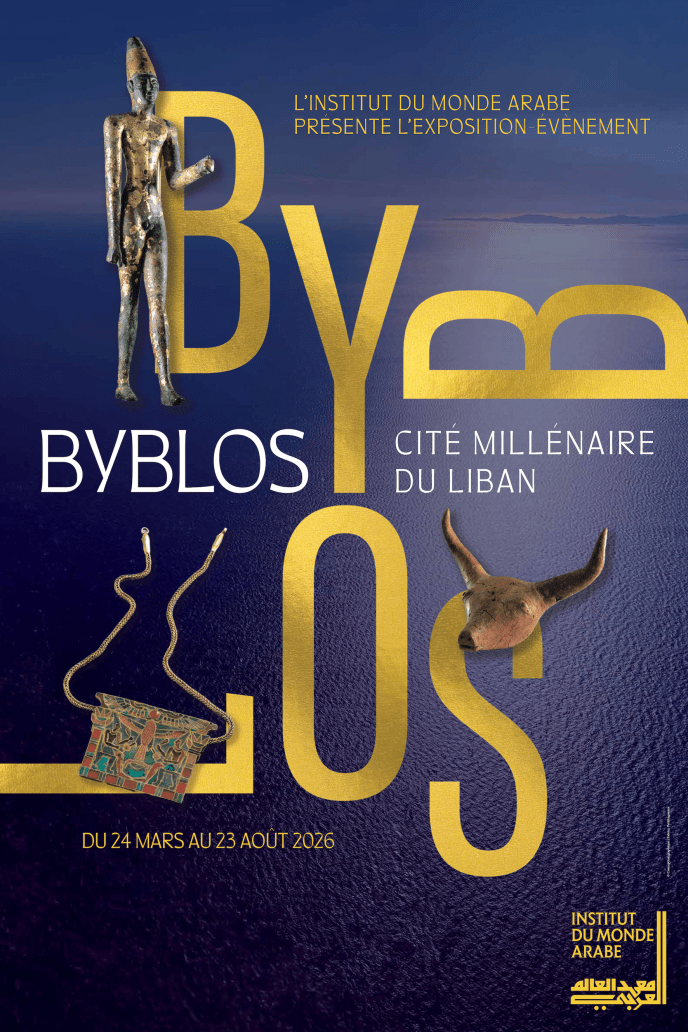
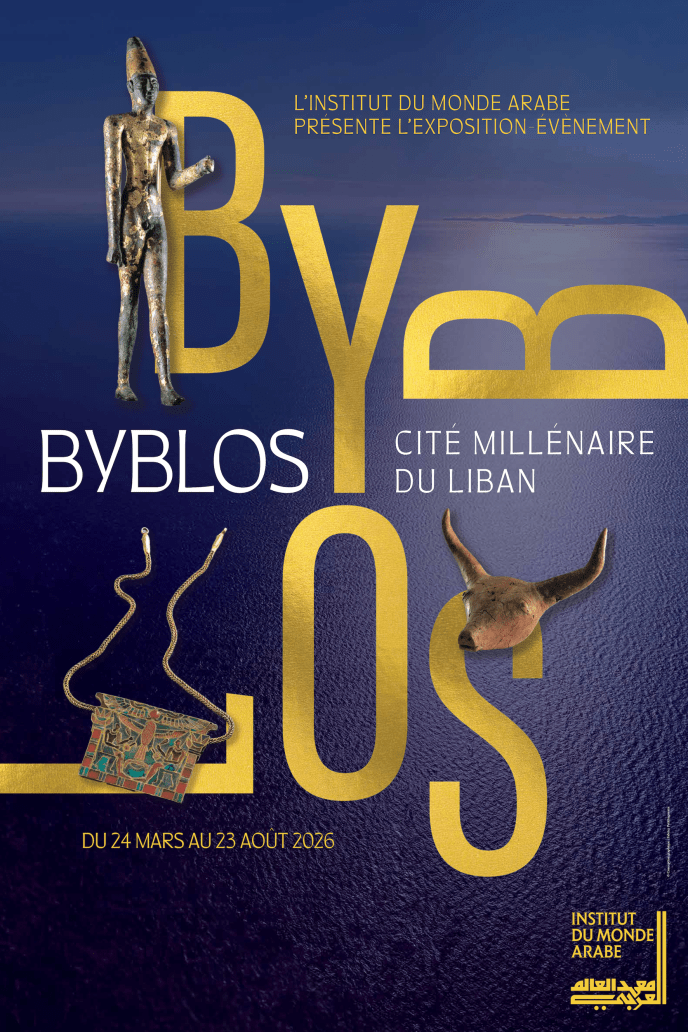
THE NEW EXHIBITION-EVENT AT THE ARAB WORLD INSTITUTE
At a time when the preservation of Lebanon’s cultural heritage and the transmission of cultural traditions are major challenges, the Arab World Institute is dedicating an exceptional exhibition to Byblos, a millennia-old city in Lebanon and one of the oldest continuously inhabited cities in the world.
Delve into the history of the world’s first international seaport: Byblos, which played a key role in Mediterranean history, connecting the Lebanese coast to Egypt, Mesopotamia, and the Aegean world; forged unique ties with the pharaohs; and played a major role in the spread of the Phoenician alphabet.
The Obelisk of Abishemou, a mosaic depicting the Abduction of Europa… : 400 exceptional artifacts, displayed in a spectacular setting, immerse you in the epic history of this city—one of the oldest in Lebanon and a UNESCO World Heritage Site. A history that began more than 8,900 years ago, featuring seafarers and merchants, kings, and pharaohs. Don’t miss this exclusive opportunity to explore the latest discoveries from the ancient port and the findings of the most recent excavations, which have unearthed the city’s South Gate and a Bronze Age necropolis—exceptionally, preserved intact to this day.
From Fishing to International Trade
Byblos is the best example of urbanization in the region, which began as early as the start of the 3rd millennium BCE. The site bears witness to continuous human occupation and development from the first settlements of a fishing community 9,000 years ago to the present day. The Bronze Age city is at the heart of the exhibition; it is one of the earliest and most impressive examples of a city-state in the Mediterranean world. But visitors are also invited to discover Phoenician, Hellenistic, and Roman Byblos, and finally to learn about those who still live today in the beating heart of the historic medieval city. Byblos is situated on a promontory overlooking the Mediterranean, 40 km north of present-day Beirut. Beginning in 3200 BCE, it became one of the Mediterranean’s major ports and remained so for over 2,000 years. The city owes this status to the unique relationship it forged, in particular, with the pharaohs of Egypt through the cedar trade. Byblos is located at the foot of vast cedar forests, whose wood has been prized since ancient times for construction and for its fragrance, and whose resin is used in mummification.
Treasures of Kings and Temples
The treasures discovered in the royal necropolis and the temples of the city dating from the early 2nd millennium B.C. are one of the highlights of the exhibition. The exhibition presents a selection of these artifacts, from the tombs of the Byblos kings Abi-Shemou and Yapi-Shemou-Abi: gold and silver tableware, gold jewelry inlaid with semiprecious stones, mirrors, ceremonial weapons, and more. Many of these pieces show a strong Egyptian influence; some even come directly from Egypt, as gifts from the pharaohs Amenemhat III and IV. The votive offerings from the Temple of the Obelisks are no less rich: earthenware figurines, gold and silver openwork axes, ceremonial daggers, jewelry… accompany the impressive procession of hundreds of bronze human figurines, some of which are gilded.
An Intact Necropolis
The site of Byblos, which Ernest Renan began exploring in the 19th century, still holds many secrets, some of which have just been uncovered and are being presented to the public for the first time, forming the central sections of the exhibition: the recent and unique discovery of a necropolis belonging to the upper class and elites of the city during the Middle Bronze Age (around 1800 BCE), which has remained entirely intact—an extremely rare occurrence in the region—is one of the exhibition’s central features. Since 2019, this necropolis has been the subject of archaeological excavations as part of a collaboration between the General Directorate of Antiquities of Lebanon and the Department of Oriental Antiquities at the Louvre Museum.
This exhibition offers a glimpse into the excavation campaign and the artifacts unearthed, which have already revolutionized our understanding of the social and economic organization of this iconic maritime city.
L’Œuvre d’Orient is a partner in the new exhibition at the Arab World Institute

Read the opening remarks for the exhibition
- Anne-Claire Legendre – President of the Arab World Institute,
- Ghassan Salamé – Lebanese Minister of Culture
- Emmanuel Macron – President of the Republic
“I would like to reiterate my gratitude for the two lessons this exhibition offers: one of resilience and syncretism, and the other of the magnificent determination of the women and men who made this exhibition possible. ”
The President of the Republic at the opening of the exhibition “Byblos, Lebanon’s Millennial City”
Lebanon: The Secrets of the Kingdom of Byblos
Saturday, April 11, 2026, at 8:55 p.m. on ARTE, and from March 21 to October 9, 2026, on arte.tv
To coincide with the exhibition “Byblos, Lebanon’s Millennial City,” ARTE is airing Philippe Aractingi’s documentary *Lebanon: The Secrets of the Kingdom of Byblos*.