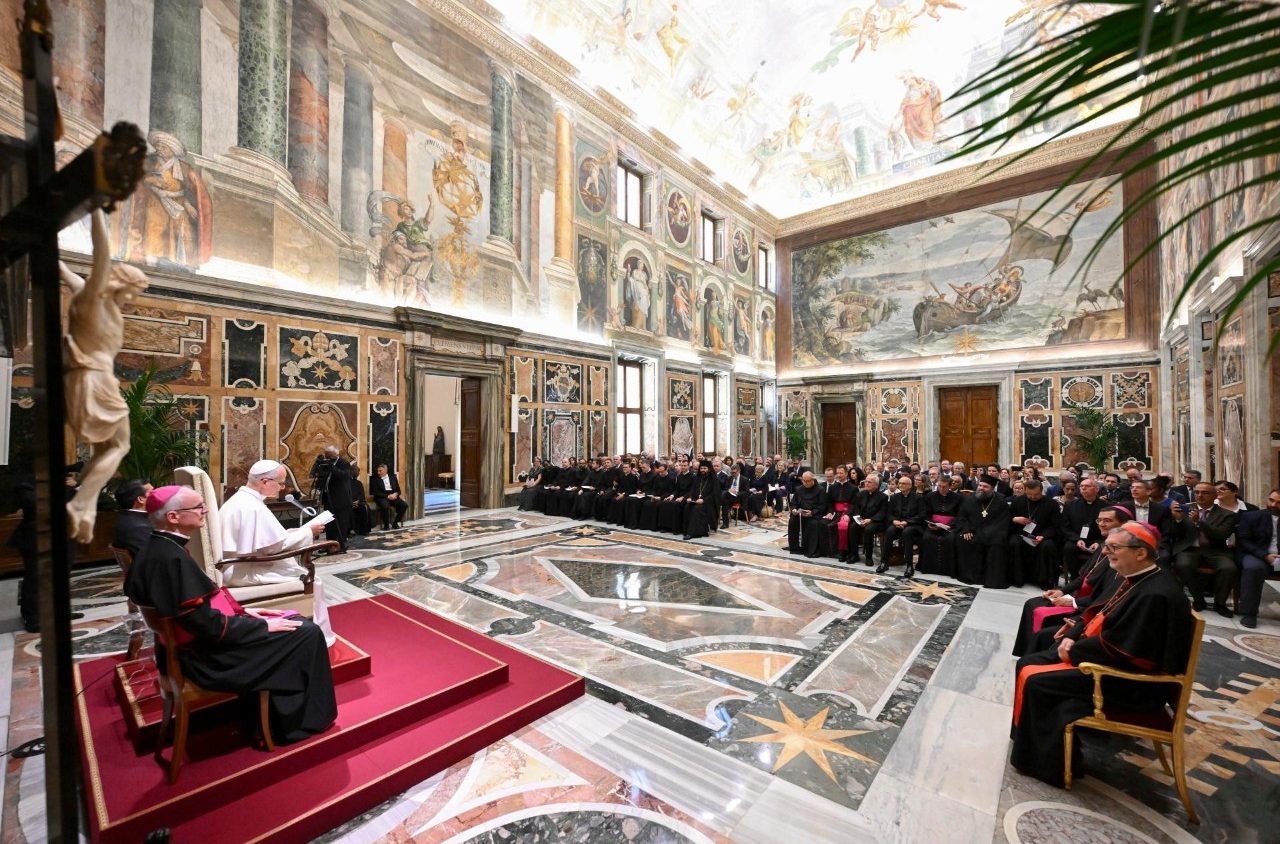
On Thursday, June 18, while receiving the members of ROACO in the Clementine Hall on the occasion of their plenary assembly, the Pope offered reflections on the tragedy of precariousness in order to “prevent, with wisdom and responsibility,” the consequences of war. The Pontiff’s remarks also drew attention to the wealth of the Eastern Catholic Churches.
Janvier Yaméogo – Vatican City
ROACO (Reunion of Charitable Organizations for the Eastern Churches) is an international coordinating body of charitable organizations from various countries that provides financial and material support to the Eastern Catholic Churches and their communities affected by conflicts in Eastern Europe and the Middle, funding initiatives ranging from emergency relief to educational, medical, and pastoral projects under the auspices of the Dicastery for the Eastern Churches since 1968. Following their assembly, ROACO members were received by the Pope on June 18 in the Clementine Hall.
A wise decision to train ministers and monks
Highlighting the work on projects to assist the Eastern Catholic Churches, Leo XIV returned in his address to the theme of this meeting: “The formation of clerics and monks in Eastern seminaries and colleges.” The Pope commended this decision to help promote the formation of ordained ministers by listening to certain experts, calling it “a beautiful sign of concrete attention toward these Churches.”
Indeed, as the Successor of Peter emphasizes, “coming to the aid of a Church does not mean merely providing it with the material means of subsistence, but also helping it to grow in its identity and in its evangelizing strength,” and this depends on the formation of ministers capable of spreading spiritual riches. Indeed, “the Eastern Catholic Churches have much to offer the entire Catholic world, which is often unaware that it harbors different ecclesial traditions within its ranks.”
The East: A Source of Spiritual and Theological Riches
Continuing his reflection, he emphasized that the fertile womb of our Mother the Church “has given birth to various spiritual and theological traditions, as well as diverse rites and disciplines that enrich one another.” “It is good for us to delve deeper into these treasures together with millions of our Eastern Catholic brothers and sisters, while hoping that progress will be made toward full unity with all the Eastern Churches.”
According to the Holy Father, the ancient Eastern Churches lead us back to the origins of the faith. “They make the light of grace shine forth through liturgies imbued with sacredness; they manifest, in the worship of praise, the mystery of God to be adored; they bear witness to the power of intercessory prayer; they offer spiritual content that fills the heart with wonder and grateful amazement at the beauty they reveal. They also encourage the faithful to express their prayer in ways that best suit their theological and anthropological characteristics.”
Understanding and Exploring the Liturgy of the Eastern Churches
As the Second Vatican Council observed regarding the Christian East and West: “It is not surprising that certain aspects of the revealed mystery have at times been better understood and expressed by one than by the other, so that these various theological formulations must often be regarded as complementary rather than opposed” (Unitatis redintegratio, 17).
“The Christian East can only be preserved if we know it,” emphasized Leo XIV; “to lose that knowledge is to impoverish the Church.” That is why it is important to invest in formation. St. John Paul II had already emphasized the importance of this, strongly reaffirming, among other things, the need to “know the liturgy of the Eastern Churches; to deepen one’s knowledge of the spiritual traditions of the Fathers and Doctors of the Christian East; […]to offer, in seminaries and faculties of theology, appropriate instruction in these subjects, intended above all for future priests” (Apostolic Letter *Orientale lumen*, no. 24).
Continuously nurture one's spiritual and sacramental life
Highlighting the connection between knowledge and charity, between open minds and active hands, the Holy Father urged donors to be steadfast in prayer and sacramental life, for good works do not bear lasting fruit unless they are nourished by the source of all good, which is God. And while it is true above all that “faith without works is dead,” as we read in the Letter of St. James (Jas 2:26), it is equally true that works are fruitless without a living faith.
Next, the Pope highlighted the discreet and charitable service carried out through the network of benefactors who provide resources to those in need, lamenting all the money that, in this dark period of history, is wasted on killing and spent by many who fuel wars. “While you give life, they sow death; while you reach out to your brother, they seek enemies to crush; while you open channels of dialogue, they seek monologues; while you chart paths of hope, they trap peoples in fear; while you build the future, they destroy the present.”
The Constant Precarity and Painful Exodus of Eastern Christians
Moving on to analyze the consequences of the conflicts, Leo XIV summed up in a single word the “precariousness” he described as “the daughter of war; there is a scourge I would like to speak about today, one that continues to bleed the Eastern Churches in particular.” It is this precariousness that causes “the painful exodus of Eastern Christians from their own territories.”
Even years later, the people remain deeply scarred by the tragedies of the past, “weakened by institutional instability, by the presence of armed gangs that divide up the territory, by a political system conditioned and often manipulated by outside actors and interests, which does not act freely but instead navigates its way through a thousand subterfuges, secret agreements, and partisan interests.” This gives rise to a state of constant precariousness that stifles opportunities for development and always falls hardest on the poor.
This is how fear and insecurity reign: “Employment is precarious, wages are paid irregularly, the healthcare system—when it functions at all—is unreliable, and education is provisional. And this is to the detriment of ordinary people, families, children and young people, the elderly, and the sick.” The Pope clearly articulates a tragedy that weighs heavily on everyone’s heart, that destroys hopes and prevents the building of a future, and this is what fuels the desire to leave, “as is the case for so many of our brothers and sisters in the faith, especially in the Middle East.”
To rekindle respect for humanity and a legitimate sense of civilization
“I would like once again to call for reflection on the consequences of war and precariousness, so that we may prevent them with wisdom and responsibility, for all this is not the result of an inevitable fate, but of free choices and therefore of morally accountable responsibilities.” History, continued Léon XIV, shows how the machinations of violence and arrogance, of power and domination, and of gains obtained without justice and without scruples, turn not only against those who suffer them, but also against those who pursue them.
“Let us pray to Jesus, the Lord of peace, and appeal to people’s consciences so that they may be moved to indignation; and may respect for humanity and a legitimate sense of civilization be reawakened,” the Pope concluded, blessing and once again thanking the donors who, inspired by the hope of Christ in the name of the Gospel, continue to commit themselves to remedying so much inhumanity.
Source: Vatican News